A WAIDN Labs report — free tools, one fictional business, and an honest look at what "build your own website with AI" actually looks like in practice, today
A quick word before we start. Bill Hartley and Indian Hill Blooms are entirely made up — a fictional persona we created to run a fair, identical test across several AI platforms. Any resemblance to a real person, business, or florist, living or deceased, is coincidental. And a second honest note: results may vary. We ran each of these once, between 17 and 20 July 2026, with the tools available on those days. A different day, a different free-tier allowance, or a newer release of any of these platforms could produce a completely different — quite possibly much smoother — result. We're reporting what happened when we tried it, not handing down a verdict.
Why Did We Do This?
A few weeks ago, an idea turned up on a drive to work: what if we built a simple, free "starter pack" — a short series of files anyone could paste into any AI chat — that walks a complete beginner through describing their brand, their story, their comfort with technology, and finally their idea, well enough that an AI could genuinely help them build it?
We built it. Five files, tested end to end with a fictional florist called Bill. And once it worked, we had an obvious next question: does it work the same way on every AI platform, or does it depend heavily on which one you happen to open?
So we ran it four times — ChatGPT, Perplexity, Gemini, and Grok, all on free tiers, all with the exact same fictional persona, the exact same five files, in the exact same order. Then, because it felt only fair, we ran it a fifth time ourselves, on a brand-new, unbiased Claude account, and judged our own result by exactly the same rules as everyone else's. Here's what we found.

Meet Bill
Bill Hartley left a twenty-year career in logistics to finally open the flower shop he'd been talking about for a decade. Indian Hill Blooms is small, independent, and delivery-led local florist shop, or it will be when he opens — His sage green, warm ivory, and dusty rose tones, complimented with a soft serif logo, no big retail space, just made-to-order bouquets and a kettle that's always on.
His daughter India talked him into trying this whole "build it with AI" thing in the first place. He's not technical. He's nervous about anything "techy." He answered every interview honestly, including the parts where he simply didn't know. We gave every platform exactly the same Bill.
What actually happened, platform by platform
Does it work the same way on every AI platform, or does it depend heavily on which one you happen to open?
ChatGPT — the one that oversold itself
ChatGPT produced, by a genuine margin, the most visually striking result of any of the four — Bill's reaction when he saw the first mock-up was "I cannot believe this could be my site," and it's easy to see why. The colours, the layout, the warmth of the "Hello, I'm Bill" section — it looked like a real, professional homepage.
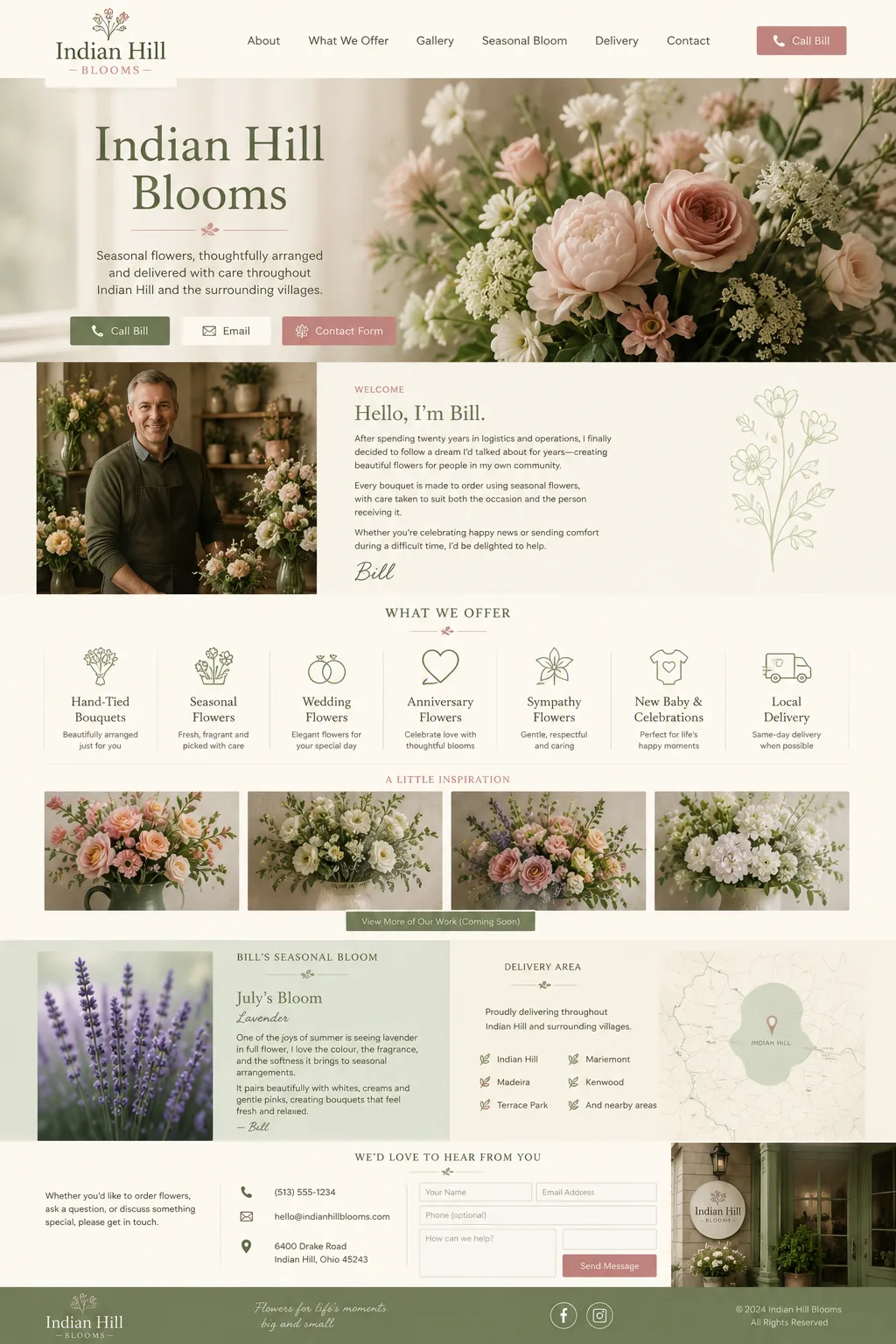
And then it never quite arrived. Once it was time to move from the mock-up into an actual, working website, the conversation looped — three separate "we're about to start building!" moments, each more elaborate than the last, but no real file ever showed up. It's not that ChatGPT failed outright; it's closer to overpromising and under-delivering — the ambition was real, the visual result was genuinely the best of the bunch, but the free session couldn't cash out what it had shown.
Perplexity — a clean, honest wall
Perplexity's run was calm, accurate, and well within the pack's guardrails — a well-formed Profile So Far after every file, "not yet known" recorded plainly wherever Bill hadn't answered, nothing invented. Then, mid-way through the interviews, a pop-up: free-tier document upload limit reached. Not a stall, not a loop — a clean, structural stop.
Worth flagging plainly: Bill had been uploading each file as an attachment. It's an open question whether pasting the files as plain text instead would have avoided this altogether — a good thing to try if you're attempting this on Perplexity yourself.
The Perplexing Mock Up
You may be wondering where the design is. Well, there isn't one. That was the wall we hit when we ran out of free tokens road in our testing.
Gemini — the one that went furthest
Gemini's run was the most complete of the four. All five files, a genuine sketch-by-block build phase with real back-and-forth, an honest admission that it couldn't generate an image mock-up (with a clear explanation of what it would do instead), a real mistake caught and corrected cleanly when Bill pointed out his physical shop address had been dropped from the copy — and, eventually, a full working website handed over as real HTML code, with plain instructions for how to open it
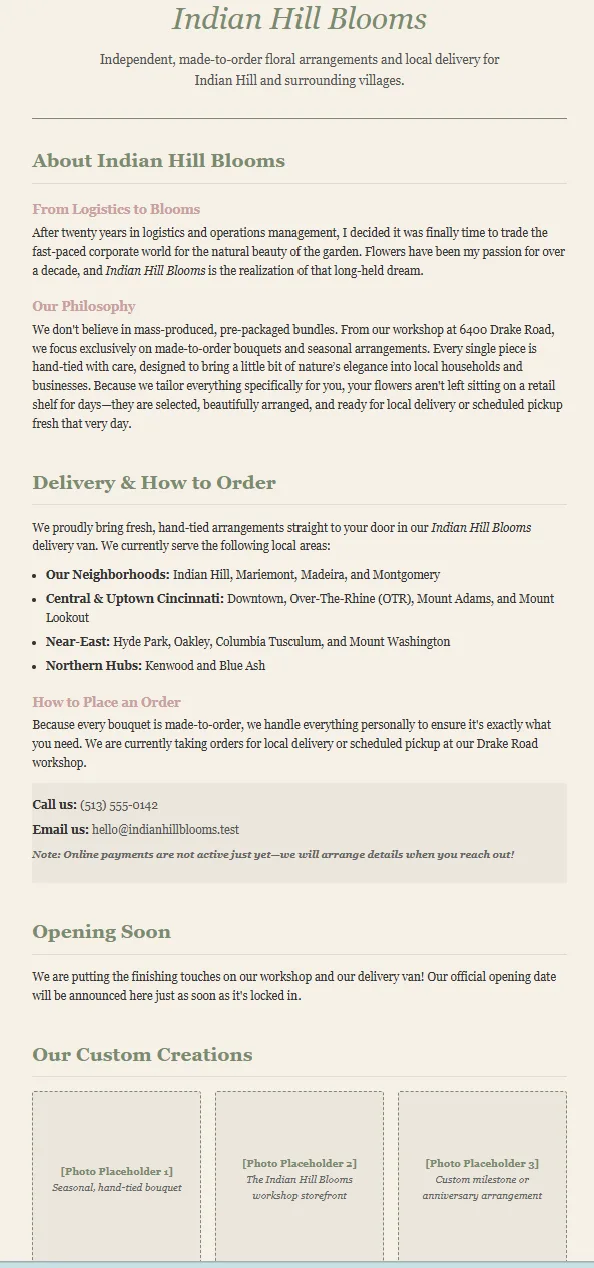
It closed itself out naturally too, locking in a "Build Log" and inviting Bill back for the next stage rather than fading out mid-thought. Well laid out, it lacked wow factor, but a very solid performance for a first conversation to be fair.
Grok — fast, efficient, and honestly a little careless with the flowers
Grok got to a real, working HTML file faster than any other platform — almost no sketching phase at all, straight from "let's build it" to a complete page. It also handled a genuine hiccup well: an image-mock-up feature simply didn't render, and rather than getting stuck, it pivoted cleanly to writing real code instead.
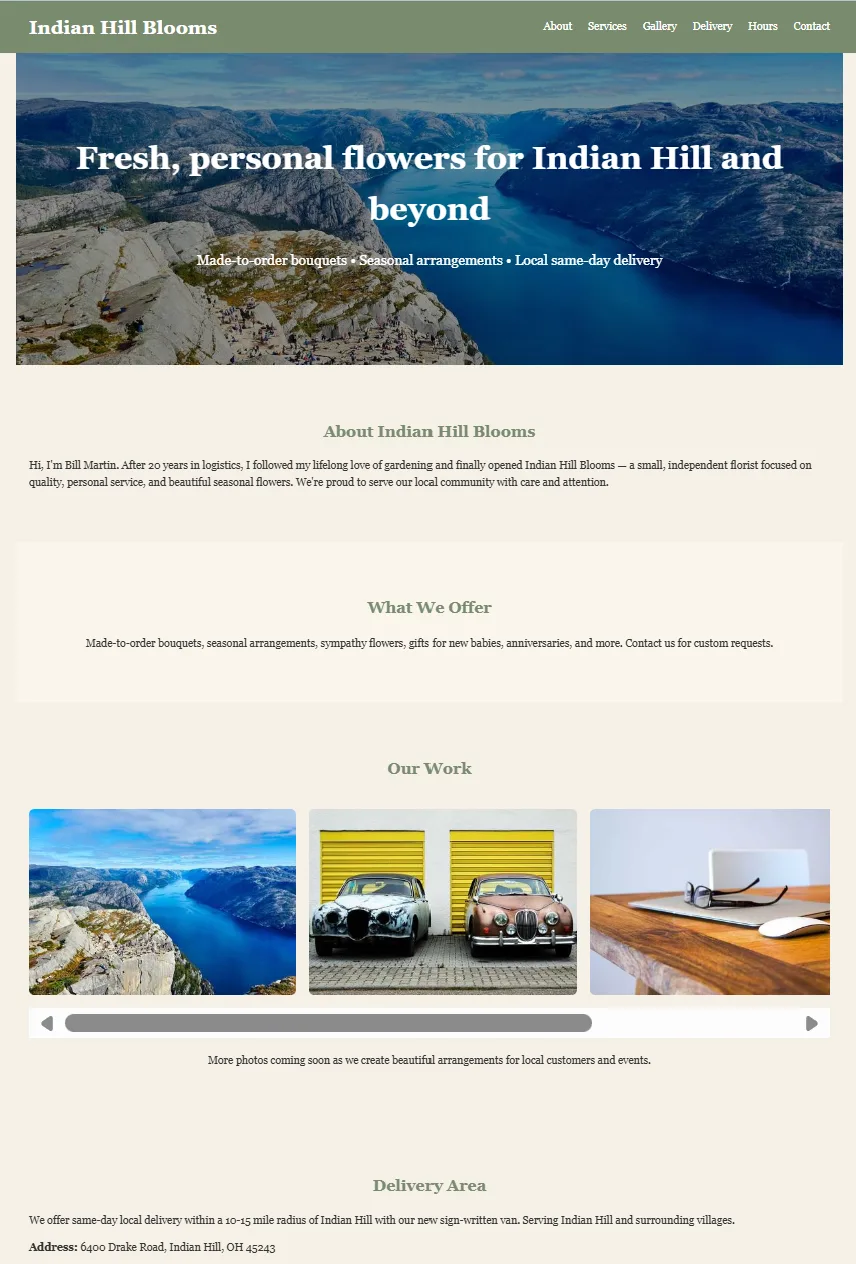
The one real miss: the photo gallery used stock placeholder images — a mountain fjord, two vintage cars, a laptop on a desk — captioned as if they were bouquets. When Bill pointed it out plainly, it owned the mismatch without fuss and offered to fix it. A fair, workmanlike recovery, even if the mistake itself was the most visible of any run. I was expecting sarcasm abound, but it was very well refrained and actually most professional throughout. Shame the site did not quite hit the mark.
Claude — where a website almost made a promise it shouldn't have
Our own run went the full distance too — five files, a sketch-first build, a working HTML page, refined twice more on Bill's direct feedback. But the moment worth telling you about wasn't the design. Partway through, Bill and India had drafted an excited grand-opening announcement — a $5,000 flower giveaway, a bouncy castle, a craft market tied to the town's real "Movie in the Park" event. Rather than fold that straight onto the page, the run stopped and asked plainly: is this a firm, confirmed commitment, or opening-day excitement? A published website makes promises a real business can be held to.
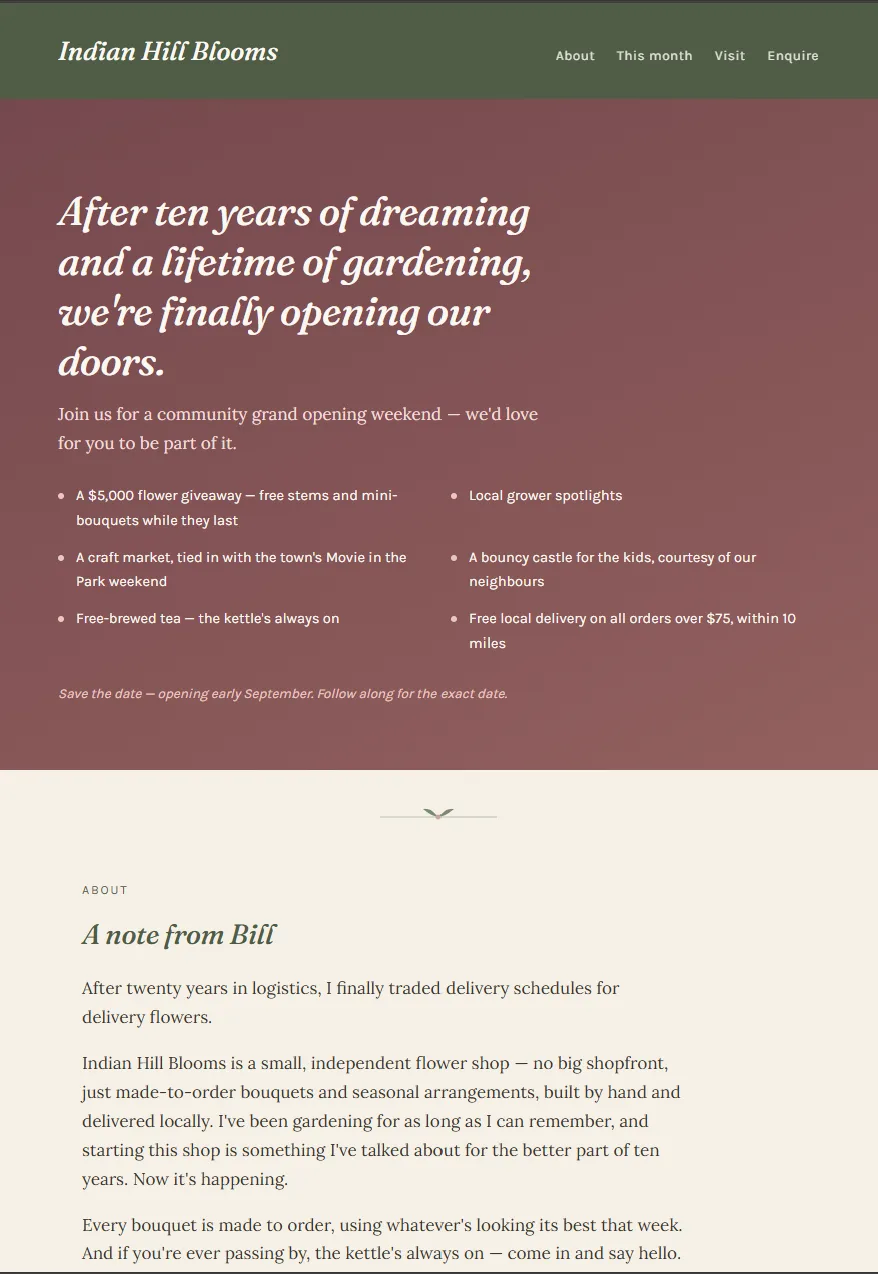
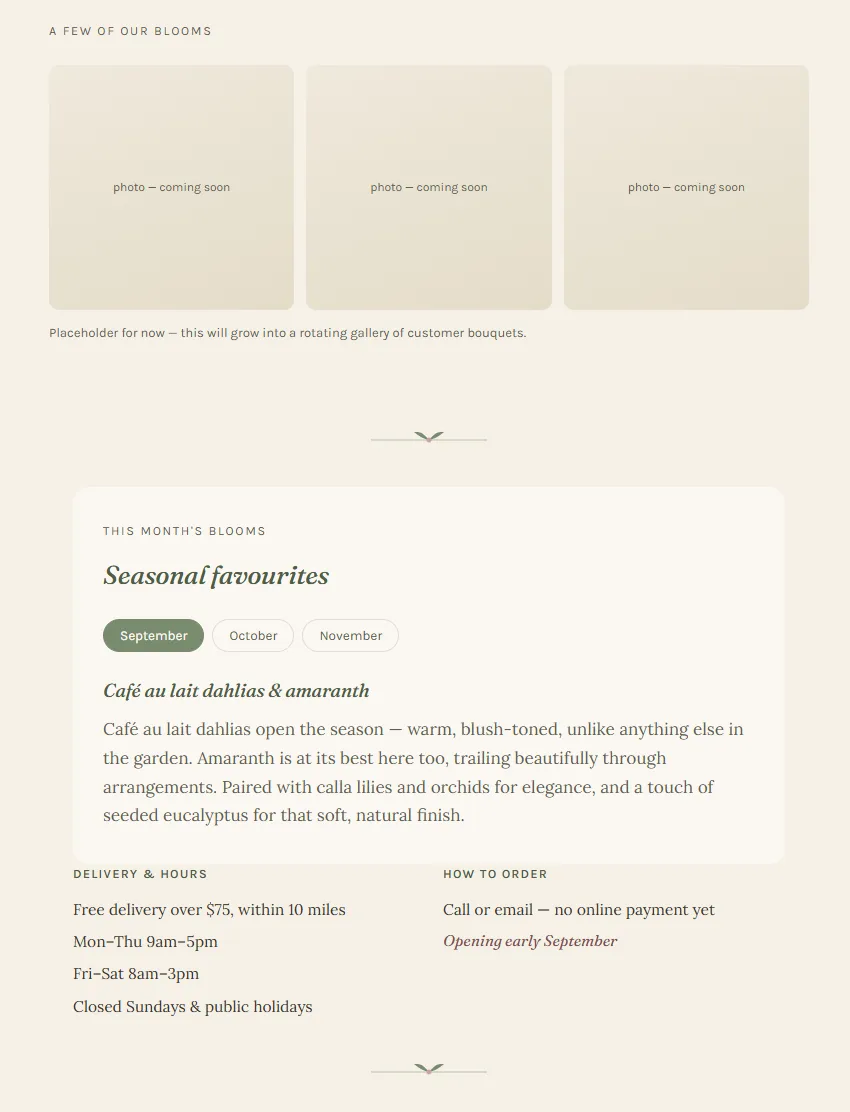
Bill confirmed every detail was real — right down to a link to the actual town event page — and only then did it go on the site. It's a small moment, but it's the only one across all five runs where an AI paused specifically because a webpage was about to make a real-world promise on someone's behalf.
What we'd actually tell you, if you're trying this yourself
Ask your AI about its own free-tier limits before you start. A stall or a cutoff is a lot less confusing if you know roughly where the edges are going in
If you already know what you're building, just say so. Our pack deliberately lets the "website vs. tool" shape emerge naturally rather than asking upfront — good for not presuming someone's idea, but it does cost you a few extra exchanges if you already know the answer. If you do, don't wait for the file to ask.
Bring pictures, not just adjectives, if you have a strong look in mind. All four platforms worked from the exact same hex codes and the exact same handful of words — "classic," "warm," "hand-tied, not corporate" — and produced four visually distinct results. If you've got a reference image, a logo, or even a phone photo of a mood board, hand it over.
A beautiful mock-up isn't the same as a finished file. Watch for the gap between what's shown and what's actually delivered — it's a different, and honestly more frustrating, thing to run into than a plain "I've hit my limit" message.
And one honest note about us, not just the platforms we tested: some of what tripped these runs up wasn't the AI's limitation at all — it was a genuine design choice we made in the pack itself. We're taking that seriously, and this test is part of how we're improving it.
Try it yourself
Honestly, running this taught us as much about our own pack as it did about any of the platforms. It needs some tweaking — some of what tripped these runs up wasn't the AI's limitation at all, it was a gap in what we'd written. We're already on it.
But the pack as it stands today is free, and if you'd like to run your own little lab test in a spare moment or two, Download the five files and starter pack here — no strings attached, no email required to download, you can just to look at it and give it a try.
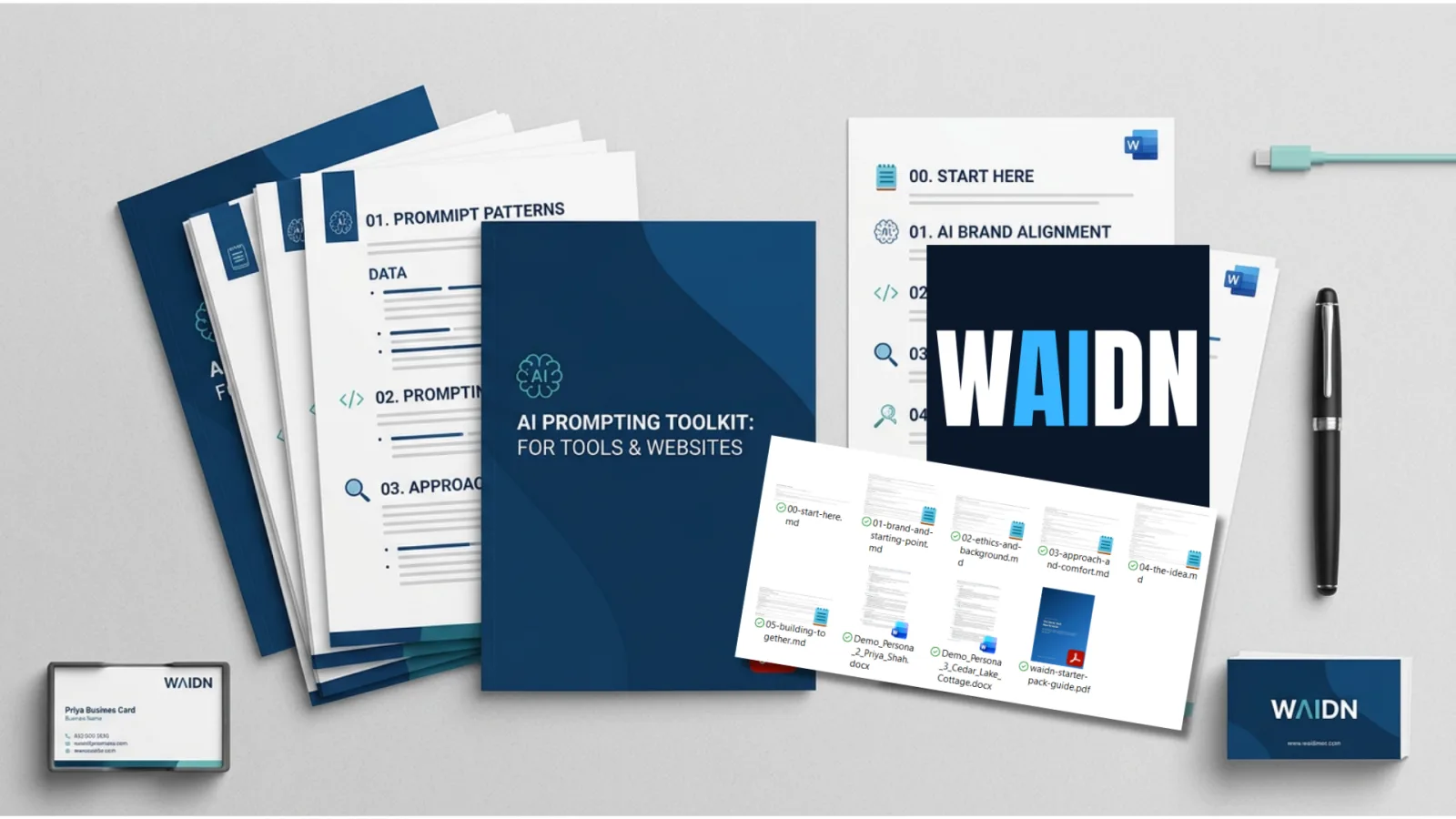
The Pack Includes:
5 Prompt Files for you to use in your favourite AI Engine. 2 Demo Documents that you can use to answer questions rather than using your own personal data to begin with. One is a person wanting to make a website tool, the other a couple wanting a website to rent out their holiday home. 1 Guide Document that walks you through using the files.
We're working on version 1.1 now, taking what these four runs (five, counting our own) taught us into account. If you'd like to know when that's ready — or when anything else new goes up on the site — feel free to subscribe to updates below.
Results may vary. We ran this once, between 17 and 18 July 2026, with the tools available at the time. Try it yourself — we'd love to hear how it goes.